Prevention Architecture

The platform operates as a continuous empirical research cycle. It helps psychologists transform their observations into structured data, combining classical methods of evidence-based psychology with the analytical capabilities of AI to design modern care standards.

Powered by the Prevention Intelligence Engine (PIE) — a constraint system that keeps generative AI within scientifically validated psychological boundaries, guaranteeing its safety and strict adherence to professional protocols.

Statistical Feedback Loop Evidence Generation Tri-axial Taxonomy Non-clinical Boundaries
AI Safety

Ethics and Safety

Prevention-AI is designed on a Copilot principle. Artificial intelligence never makes diagnoses, never makes decisions for the specialist, and does not replace a human. It serves as an expert assistant, relying on strict methodological frameworks embedded in the database: WHO guidelines, Functional Behavioral Assessment (FBA) protocols, and Cognitive Behavioral Therapy (CBT) approaches.

Core Mechanism

Multidimensional Prevention Matrix

The system does not allow "free fantasizing" by algorithms. Any specialist request is processed through a strict state matrix, guaranteeing the validity of recommendations.

X_STAGE_VALUES

X-Axis: Process Stages

Determines the exact operational phase of the intervention cycle:

  • X1_Problem — Acute tension identification
  • X2_Diag — Non-clinical preventive screening / structured checkup
  • X3_Goal — Setting limited de-escalation milestones
  • X4_Action — Deployment of micro-action protocols
  • X5_Eval — Automated reflection and outcome tracking
Y_LEVEL_VALUES

Y-Axis: Severity Levels

Establishes the safety perimeter and determines routing thresholds:

  • Y1_Normal — Standard age-related crisis
  • Y2_Risk — Accumulation of subclinical risk factors
  • Y3_Problem — Manifested behavioral or communicative crisis
  • Y4_Crisis_Clinical — Hard boundary for warm routing to a specialist
M_MODALITY_VALUES

M-Axis: System Modalities

Categorizes the physiological or ecological origin of the stress vector:

  • M1_Biology — Age-related and neurodevelopmental shifts
  • M2_Psychophysiology — Somatic markers and stress responses
  • M3_Cognition — Internal behavioral cycles, beliefs, and scripts
  • M4_Social — Microsystem dynamics (family and peers)
  • M5_Environment — Macrospaces (institutional and digital contexts)
Actor Roles (Target Interface)

Dynamic context filtering based on the certified user interface: Psychologist (methodological journals), Teacher (classroom dynamics), or Administrator (macro reports).

Organizational Scale (Target Radius)

Determines the target sociological system size for the data cycle: IndividualFamilyGroupCommunitySociety.

Unified Taxonomy Passport Metadata

To ensure full semantic continuity between Tier 1 consumer apps and Tier 2 specialist spaces, each session generates an isolated, PII-free cryptographic passport. This passport tracks behavioral change dynamics (movement from baseline anomaly to target de-escalation) and evaluates context continuity in longitudinal logs, without revealing personal stories.

Topological Atlas

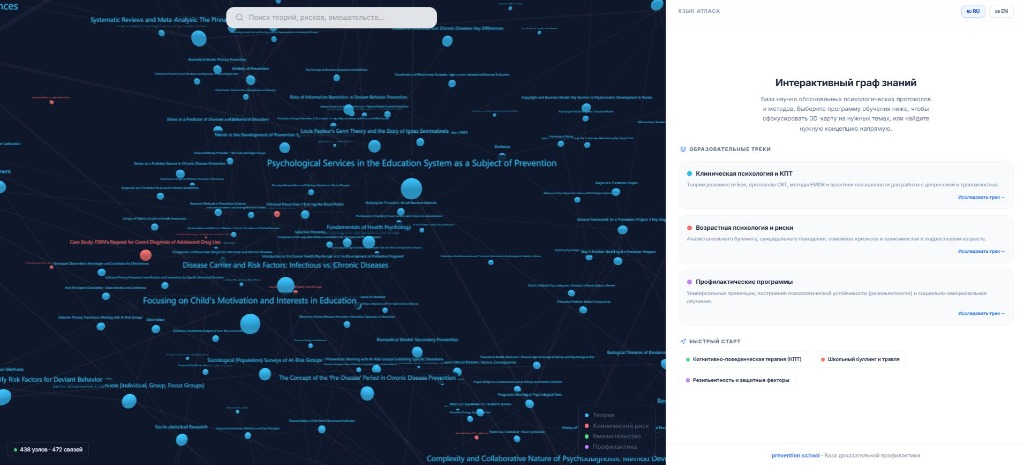
Semantic 3D Graph of the Prevention Academy

Instead of treating nodes as simple links, the system maps connections as a semantic galaxy of 438 structural nodes and over 1,800 directed edges. This topological structure serves as a catalog of safe pathways, guiding the specialist along developmental, clinical, and preventive tracks.

3D topological knowledge graph visualization
Cognitive Core

System Prompt Architecture

We utilize a fully transparent, highly deterministic prompt hierarchy. It establishes non-clinical boundaries, isolates sensitive diagnostics, and safely guides the LLM along validated protocols. This entire structure is open for collaborative governance and ongoing scientific review.

graph TD A[Main System Prompt
Prevention-AI] --> B(Frontend: Specialist Terminal) A --> C(Backend: Client Apps & Core) %% Frontend Branch B --> B1(Document Architect) B --> B2(Methodological Expert) B --> B3(Co-pilot / Copilot) B --> B4(Smart Fill) B1 --> B1a[IEP / Multidisciplinary Teams / Group Plans / Safety] B2 --> B2a[FBA / Profiles / Program Audits] B3 --> B3a[Fast AI Synthesis] B3 --> B3b[Role and Risk Analysis] B4 --> B4a[DAP Session Structuring] %% Backend Branch C --> C1(Client Intake and Routing) C --> C2(Diagnostic Module) C --> C3(Consultative Companions) C1 --> C1a[Intake Intercepts
Moral Panic, Adoption] C1 --> C1b[Taxonomy Mapping
Hard Provider Gateways] C2 --> C2a[Diagnostic Axioms
PII Protection] C2 --> C2b[Deep Dive
Intermediate Finding Generation] C2 --> C2c[Intake Summary
Data Synthesis] C3 --> C3a[Navigator for Parents] C3 --> C3b[Relationship Bridge] C3 --> C3c[Companion for Educators] C3 --> C3d[Family Bridge
Shuttle Mediation] C3 --> C3e[Sprint Planning
Multi-Problem Sprint] C3 --> C3f[Dynamic Accompaniment
Discover/Summarize/Mobilize] classDef core fill:#1e293b,stroke:#475569,stroke-width:2px,color:#fff; classDef frontend fill:#0ea5e9,stroke:#0284c7,stroke-width:2px,color:#fff; classDef backend fill:#10b981,stroke:#059669,stroke-width:2px,color:#fff; classDef leaf fill:#0f172a,stroke:#334155,stroke-width:1px,color:#cbd5e1; class A core; class B,B1,B2,B3,B4 frontend; class C,C1,C2,C3 backend; class B1a,B2a,B3a,B3b,B4a,C1a,C1b,C2a,C2b,C2c,C3a,C3b,C3c,C3d,C3e,C3f leaf;
Frontend (Terminal) Backend (Core) Executable Prompts

Frontend Terminal Prompts

Document Architect

Plans & Reports: Individual Consultations, IEP, Group Work, Safe Environment

Generates all main types of psychologist documents from raw data, structures according to methodology, provides recommendations, and formats into a print-ready document.

Methodological Expert

FBA & Profiles

Compiles Functional Behavioral Assessment (FBA) and psychological profiles, mapping student behavior to A-B-C triggers.

Case Copilot

Case Copilot

Analyzes roles and calculates hidden social and destructive risks.

Smart Fill

DAP Session Structuring

Automatically transforms unstructured voice dictation into strict Data, Assessment, and Plan (DAP) fields for professional journals.

Backend Core Prompts

Intake and Routing

Intercepts & Provider Routing

Safely handles acute intake scenarios (e.g., adoption panic) and maps conversational taxonomy to provider psychological profiles.

Diagnostic Module

Deep Dive & Intake Summary

Post-processing of test results to generate a single empathetic "deep dive" question and synthesize PII-stripped evidence summaries.

Companions

Parent Navigator & Relationship Bridge

Manages relationship support logic (family or couple). Ensures absolute neutrality, privacy protection, and deflects security threats away from the AI.

Shuttle Mediation (Family Bridge)

Translating Positions & NVC

Translates party positions through the lens of Nonviolent Communication (NVC), helping the parent see the teen's hidden needs, and the teen understand the adult's anxiety without disclosing private chat details.

Sprint Planning

Multi-problem Deconstruction & Sprints

Decomposes dense incoming messages with multiple complaints into 2–4 independent themes. Identifies priority sprint focus and formulates one micro-action step for the next 24 hours.

Dynamic Accompaniment

Dialogue Phase Management

Tracks therapeutic contact depth and switches response logic (Discover → Summarize → Mobilize), separating facts from parental interpretations and offering ready-made letter/request templates.

Security Core

Diagnostic Axioms

Absolute unshakable baseline: prohibits clinical diagnoses, moralizing, and mandates routing to emergency services (e.g., 911) when life-threatening data is inputted.

Runtime Factory

Evidence Factory: Classifier → Protocols → Sprints → Outcome

In addition to the macro-research loop, Prevention-AI already utilizes a closed operational cycle in every paid session. Raw chat is never saved as evidence; the factory outputs structured keys, protocol IDs, sprint metadata, and user ratings that can be aggregated to determine protocol efficacy.

Step 1 · Classification Automatic Problem Classifier

Each user utterance is bound to taxonomy coordinates: problem code, category code, severity (Y-axis), modality cues (M-axis), and prevention vector. Unknown themes are flagged for review without saving message text.

Step 2 · Protocoling Executable Protocol Selection

The engine selects bounded micro-interventions from the protocol catalog for the current stage (X1–X5). Guidelines are injected into the AI runtime; applied protocols are logged at every assistant step.

Step 3 · Sprint Case Sprint Cycle

Dialogue is organized as short case sprints: tension identification → focal problem exploration → escalation containment → evaluation → next step decision. Each sprint contains a unique ID, focus node, and session stage, so the same taxonomy language covers all utterances and sessions.

Step 4 · Evaluation User Outcomes Scorecard

When a sprint closes, the user evaluates the cycle: helped / partially / didn't help / got worse, plus optional scientific scales (clarity, relief, confidence in next step, alliance, micro-action status). Outcomes are linked to applied protocols and focal taxonomy, measuring what worked without retaining narratives.

From Telemetry to Evidence: Instead of collecting raw personal chats, the platform captures only anonymized event signals (such as classified problem categories, protocol steps, and user-rated sprint outcomes). These aggregated data points generate real-time statistical maps, showing which prevention protocol works best for a specific problem. This approach automatically builds a comprehensive, high-fidelity statistical pool for public health decision-makers — something traditional paper reporting systems could never achieve.

The Future of Diagnostics

AI-Driven CAT and Shadow Scoring Roadmap

The platform moves beyond classical static questionnaires. By analyzing natural conversation, we create a continuous background diagnostic loop that evaluates risk factors without disrupting the therapeutic flow.

Phase 1 · Intake Taxonomy Tag Picker

Immediate dialogue initiation via dynamic tagging, replacing static forms with real-time mapping of structural themes (e.g., REL_FAM, DEV_EMO).

Phase 2 · Test Banks Question Pool Architecture

Decomposition of validated psychometric scales (depression, anxiety, PTSD) into atomic elements, enriched with IRT (Item Response Theory) weights, LLM system prompts, and contextual guardrails.

Phase 3 · Analysis Shadow Scoring

A background AI module that parses free text and automatically maps client narratives against diagnostic scales without explicit questions, governed by strict context filtering.

Phase 4 · Dynamic Testing AI-Driven CAT

Computerized Adaptive Testing where the LLM organically weaves the next most statistically valuable question from the test bank into the natural flow of conversation.

Phase 5 · Specialist Interface Diagnostic X-Ray

An interactive dashboard for specialists displaying screening probabilities (but not clinical diagnoses) and anonymized conversational evidence, plus a test builder for researchers.

Phase 6 · Validation Scientific Calibration

Collection of anonymized statistics to compare AI shadow scoring against traditional forms, calibrating IRT weights for continuous accuracy improvement.

Macro-Analytics

Anonymized Aggregated Analytics (Design)

Local client-side logging (IndexedDB) and edge PII stripping are design choices ensuring individual interactions can become structured research signals rather than just passive charts, feeding into the evidence cycle described above.

The target architecture pushes behavioral typologies and risk vector matrices into analytics warehouses (e.g., BigQuery) so institutions can track regional stress patterns at an aggregate level. This governance layer is not yet operating at a national scale; institutional pilots aim to validate the pipeline end-to-end in localized contexts.

Vector Ontological Search

We leverage high-performance vector databases (Azure AI Search / Vertex AI Vector Search) to perform deterministic matching between natural language input and our fixed prevention ontologies, forcing the model to stay on script.

Decoupled Edge Isolation

Local PII (names, specific locations) never reaches the LLM cloud API. The edge application strips identifiers before generating embeddings, guaranteeing HIPAA and GDPR compliance for any subsequent macro-analysis.

"This is how empirical science, cutting-edge preventive practice, and regional governance will finally operate in a single, real-time data feedback loop. By turning everyday field activity into a structured, verifiable source of evidence, we aren't just applying existing protocols — we are establishing the future standards of AI-assisted psychological care."

— Roman Dubrovsky, PhD, Platform Founder