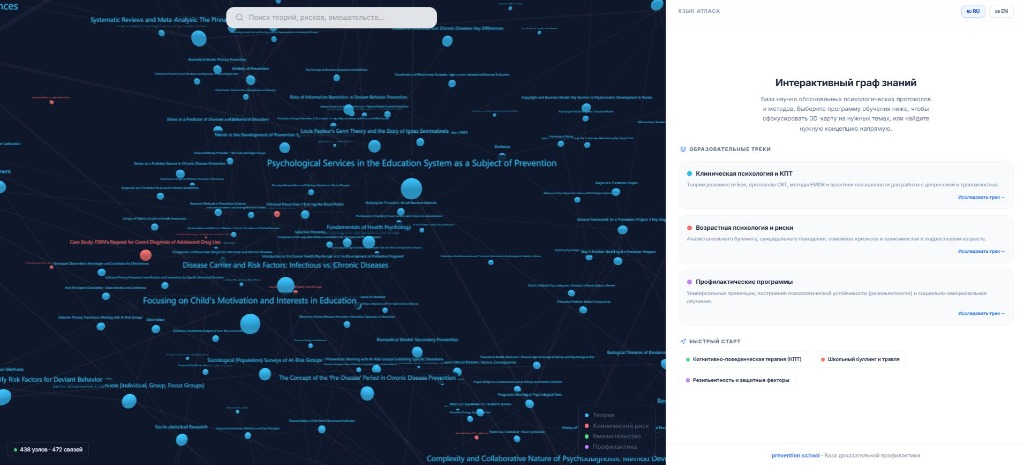
Prevention taxonomy
A shared, deterministic language for risk factors, protective factors, and outcomes across family, specialist, and administrative layers. It bounds AI within validated behavioral standards.
The platform operates as a continuous, empirical research loop. It transforms raw field signals into standardized, structured data, combining a three-axis prevention taxonomy and an evidence-informed knowledge base with an active analytical contour designed to programmatically validate and engineer future standards for AI-assisted care.
Powered by the Prevention Intelligence Engine (PIE)—a deterministic ontology that bounds generative AI within validated prevention science, not open-ended clinical advice.
Three coupled layers turn everyday prevention work into standards the industry can audit—not a static expert system relocated onto an LLM.
A shared, deterministic language for risk factors, protective factors, and outcomes across family, specialist, and administrative layers. It bounds AI within validated behavioral standards.
Evidence-informed guidance attached to concrete prevention situations in real time—the matrix is injected into the AI runtime, not left as disconnected literature.
The third layer closes the system: anonymized field signals continuously refine what the platform deploys next, producing self-validating prevention standards instead of one-off guidelines.
The engine above is not a separate product—it is the operational pipeline that connects taxonomy coordinates to measurable protocol updates.
Teenology logs and specialist intake summaries are tokenized and mapped to taxonomy coordinates at the PWA layer, with PII stripped at the edge.
Anonymized telemetry enters an isolated BigQuery research contour for risk clustering and macro-epidemiological tracking.
Verified statistical deltas adjust prompt boundaries, RAG injection, and routing—codifying benchmarks for AI-assisted psychological support.
Generic LLMs fail in volatile social environments because they drift into unvalidated psychotherapeutic advice. The PIE framework enforces strict topological boundaries, operating exclusively within the domain of Primary and Secondary Public Health Prevention Science.
The system is architected to explicitly reject the clinical/psychotherapeutic paradigm. It does not treat clinical pathologies, handle deep trauma, or issue medical assessments. Instead, it acts as an immediate structural stabilizer for communication, reinforcing systemic buffers before vulnerabilities manifest as medical or behavioral crises.
If natural language tokens breach deterministic thresholds (detecting clear indicators of self-harm, systemic violence, or criminal patterns), the LLM layer is bypassed entirely. The platform locks the session and triggers a hot-route handoff to geo-targeted human crisis infrastructure.
The PIE engine does not allow open-ended semantic drifting. Every incoming natural language token is programmatically ingested, vectorized, and forced to map onto a strict, 5D state matrix compiled directly from our production codebase (derived from WHO prevention standards).
Defines the exact operational phase of the intervention loop:
X1_Problem — Acute identification of frictionX2_Diag — Non-clinical behavioral diagnosticsX3_Goal — Setting bounded de-escalation milestonesX4_Action — Deploying micro-action protocolsX5_Eval — Automated reflection and outcome trackingEnforces the safety perimeter and determines routing thresholds:
Y1_Normal — Standard age-appropriate crisisY2_Risk — Sub-clinical risk factors accumulationY3_Problem — Manifested behavioral or communication crisisY4_Crisis_Clinical — Hard boundary for human hot-routingCategorizes the physiological or ecological origin of the stress vector:
M1_Biology — Age-related and neurodevelopmental shiftsM2_Psychophysiology — Somatic and stress-response markersM3_Cognition — Internal behavioral loops, beliefs, and scriptsM4_Social — Micro-system dynamics (family and peer environments)M5_Environment — Macro spaces (institutional and digital contexts)Dynamic context filtering depending on the certified user interface: Psychologist (methodological logs), Teacher (classroom dynamics), or Administrator (macro reports).
Defines the target sociological system size for the data loop: Individual → Family → Group → Community → Society.
To ensure total semantic continuity between Level 1 consumer apps and Level 2 specialist spaces, every operational session generates an isolated, non-PII cryptographic passport. This passport tracks the BEHAVIOR_DELTA (movement from baseline anomaly to target de-escalation) and evaluates context continuity across long-term logs without exposing the underlying personal narratives.
By enforcing local client-side logging (IndexedDB) and stripping personal identifiable information (PII) at edge routers, the platform transforms individual user interactions into structured research signals—not passive trend charts, but inputs to the evidence production engine described in the operational triad.
Aggregated behavioral typologies and risk-vector matrices flow into enterprise analytics warehouses (e.g., BigQuery). Institutions can track regional stress maps and micro-epidemics while the same contour closes the loop: statistical deltas refine which protocols the AI deploys next.
We use high-throughput vector databases (Azure AI Search / Vertex AI Vector Search) to perform deterministic matching between natural language input and our fixed prevention ontologies, forcing the model to stay on-script.
The processing architecture utilizes stateless cloud worker nodes to ensure raw text analysis remains ephemeral and completely separated from the storage layers that feed the macro research databases.
"The ultimate goal of the Prevention AI Platform is not to automate human empathy, but to construct a resilient, scalable digital infrastructure where empirical science, frontline prevention practice, and regional governance finally operate in a single, real-time data feedback loop. By turning day-to-day field activity into a structured, verifiable source of evidence, we aren't just applying existing protocols—we are validating the future standards of AI-assisted psychological care."