While experts debate whether artificial intelligence will replace psychologists, neural network applications are confidently occupying a very different niche: they are becoming indispensable assistants for therapists themselves. In just a few years, the market for such solutions has traversed several evolutionary stages.
Stage 1: Naive Techno-Optimism (2021–2023) — "The Chatbot as Therapist"
Initial attempts to introduce AI into psychology tried to solve the human resource deficit head-on. Developers took generic text models, wrapped them in polished interfaces, and put clients directly in a chat with a bot. The premise was that algorithms could simulate empathy and navigate therapeutic dialogue. However, bots were unable to form a therapeutic alliance, "hallucinated" at the slightest departure from standard scripts, and remained completely blind to acute crisis states.
Stage 2: The Era of Unvetted Prompts and Privacy Hazards (2023–2024)
With the widespread availability of powerful Large Language Models (LLMs), therapists began experimenting with neural networks independently. Public chats were flooded with pages of confidential text: session transcripts, audio logs, and rough case notes accompanied by requests to "generate a summary" or "suggest hypotheses."
This exposed two fundamental vulnerabilities:
- Catastrophic breach of confidentiality: uploading sensitive client personal data to third-party servers without any de-identification.
- Clinical superficiality: Psychology demands adherence to evidence-based protocols, whether CBT, EMDR, polyvagal theory, or the biopsychosocial model. A generic LLM boasts encyclopedic breadth but lacks clinical focus: it merely predicts the most statistically probable text, completely oblivious to where the line lies between a clinical intervention and casual lifestyle advice.
Stage 3: AI as Secretary and Administrative Assistant (2025–2026)
The market responded to spontaneous AI use by launching dozens of B2B applications. They manage administrative drudgery well: scheduling, voice-to-text transcription, and basic document digitization (e.g., standard analytical reports or consultation logs). AI became a competent secretary.
Yet as soon as these platforms ventured into "smart" clinical guidance, they stumbled again. To force a base neural network to reason clinically, developers assembled massive, cumbersome prompt libraries. Systems became trapped in their own architectural bottlenecks: responses remained vague, token consumption skyrocketed, and the risk of hallucinations was never resolved.
Stage 4: The Therapist's Cognitive Exoskeleton (2026–2027)
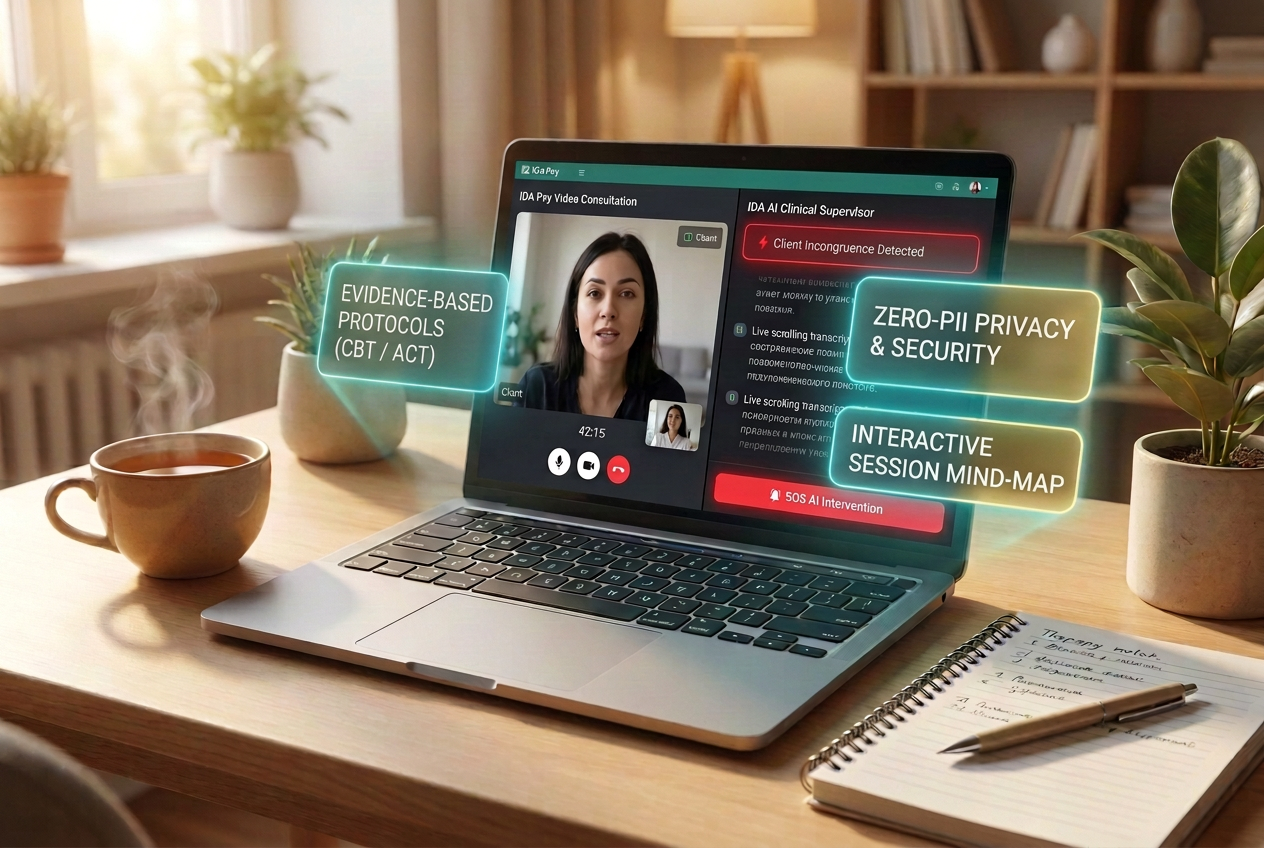
It became clear that to offer genuine support to therapists, specialized applications need more than secretarial utilities. They require an architecture built on a dedicated, isolated cognitive core powered by specialized RAG frameworks — not merely a knowledge store, but a robust system of constraints keeping the AI strictly within the guardrails of evidence-based clinical psychology. This core relies on a strict multidimensional taxonomy, mapping every query against matrices of process stages, severity levels (with rigid clinical intervention boundaries), and stress modalities. This eliminates arbitrary algorithm hallucination and establishes a genuine professional alliance: the AI navigates methodology, while the human specialist provides therapeutic presence and clinical judgment.
The synthesis of workflow automation and a cognitive core creates powerful synergies, yielding tools that transform daily clinical practice:
1. Real-Time Clinical SOS-Supervisor
Encountering a dialogue impasse, aggressive resistance, or an unexpected turn in conversation? During a live video session, with a single click, the therapist activates the SOS button. Within 2 seconds, the system correlates session dynamics with the clinical taxonomy and delivers a concentrated prompt: an alternative hypothesis, an intervention vector (CBT/SFBT/Gestalt), or a reconnecting question. The client sees nothing, while the therapist receives instantaneous real-time grounding.
2. SOAP / DAP Notes in Seconds
No more agonizing reconstruction of meetings from memory at the end of the day. The AI transforms de-identified notes or transcript snippets into impeccable international-standard documentation:
- S (Subjective): subjective experiences and presenting complaints;
- O (Objective): objective markers, observed affect, and behavioral indicators;
- A (Assessment): clinical assessment and process dynamics;
- P (Plan): therapeutic targets and agenda for subsequent sessions.
3. Post-Session AI Supervision & Case Dynamics Review
The practitioner's work does not end when the video call disconnects. Immediately after the session, the system provides in-depth supervision analytics: highlighting therapist blind spots, verifying therapeutic contract alignment, checking verbal markers against evidence-based protocols, and offering alternative hypotheses for peer or formal supervision. When external consultation is required, the system generates a de-identified supervision token — a secure case digest preserving 100% client anonymity.
4. Functional Behavior Assessment (FBA) & Behavior Intervention Plans (BIP)
For complex cases involving compulsive, disruptive, or avoidance patterns, narrative notes are insufficient — rigorous behavioral matrices are essential. The AI structures session dynamics according to empirical behavioral science standards:
- FBA (Functional Behavior Assessment): deconstructs incidents into rigorous "Antecedent → Behavior → Consequence" (ABC) chains and utilizes the cognitive core to isolate the primary behavioral function (attention seeking, task avoidance, sensory reinforcement, or tangible access);
- BIP (Behavior Intervention Plan): synthesizes the verified behavioral function into an actionable clinical strategy — proactive environmental modifications, socially adaptive replacement behaviors, and reinforcement schedules.
5. Contextual Pre-Briefing
Before a session begins, there is no need to re-read extensive notes from months ago. Two minutes prior to the call, the AI prepares a concise 5-point briefing: primary problem history, previous session resolution, homework status, active triggers, and emotional risk areas. The therapist enters the room centered and prepared.
6. Client Takeaways Without Therapeutic Jargon
Following a session, clients typically retain less than 30% of key insights. The system generates a personalized post-session takeaway in one click: core conclusions, self-observation prompts, and home exercises written in compassionate, clear human language without intimidating clinical labels.
7. Zero-PII Architecture: Uncompromising Data Ethics
The primary hurdle to adopting AI in therapy and healthcare is privacy. Next-generation tools adhere to strict Zero Personally Identifiable Information principles:
- Rigorous Local Cryptography (SQLCipher, AES-256): All consultation history and client files are stored exclusively on the therapist's local device. Even in the event of hardware theft, an intruder sees only unreadable encrypted bytes.
- On-the-Fly Absolute De-identification: Before any text touches cloud intelligence, local sanitization algorithms strip all names, locations, dates, and contact data. The model evaluates only clinical essence without knowing identity.
8. Infrastructure for Psychological Centers: Next-Generation B2B Module
While for private therapists AI serves as an individual cognitive exoskeleton against burnout, for psychological clinics and mental health centers it acts as a scalable engine for quality control, capacity management, and client retention:
- Compatibility Match: Algorithms match intake profiles with proven empirical outcomes of specific clinic specialists, drastically minimizing early dropouts.
- Executive Dashboard with Segmented Access: Leadership monitors aggregated health metrics (utilization, conversion flow, total hours) without access to confidential session notes, upholding patient confidentiality.
All of this is no longer a theoretical wishlist. Today, this is the IDA Psy platform, built on maximum accessibility for the professional community with comprehensive free core tools and subscriptions only for high-leverage cognitive features that eliminate administrative drudgery.